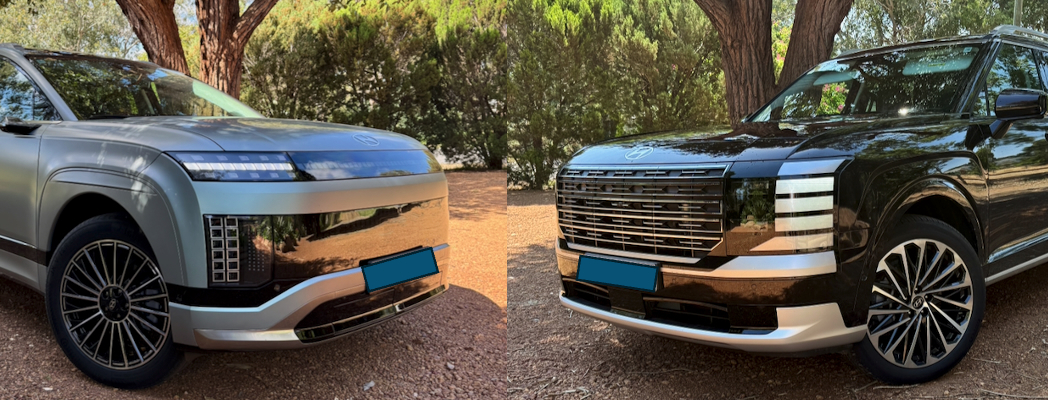
Hyundai’s big two serve up the space requirement with two distinct and modern drivelines but talking the same language.

The Palisade Calligraphy Hybrid feels like it was designed with wide American highways and even wider expectations in mind — and that’s not a bad thing. For Australian buyers who prioritise space, comfort, and effortless touring ability, it’s a compelling package. But if your daily drive involves tight city streets and a desire for something a bit more nimble, this big Hyundai might feel like it’s speaking with a slightly different accent.

The Ioniq 9 however takes the Palisade’s family-first formula and electrifies it with real intent. It’s big, yes — but it feels smarter, sharper, and more in tune with where the Australian market is heading. If you can live with charging logistics, the payoff is a driving experience that’s effortlessly quick, impressively refined, and just that little bit more forward-thinking.
Although both cars share near identical road space, the platforms are non-interchangeable. Pallisade’s traditional ICE/EV hybrid set-up is quite different to the Ionic’s and the electric unit has its own E-GMP platform. But despite this, and the around $15k price difference (battery packs tend to do this) this pair of cruisers deserve a joint examination.

There’s a certain Hollywood polish to the Hyundai Palisade Calligraphy Hybrid — like it’s been cast for a suburban family drama set somewhere between Santa Monica and Scottsdale. After a week behind the wheel, it’s clear this big Hyundai hasn’t just been influenced by the US market; it’s been thoroughly marinated in it. The question is whether that flavour suits Australian tastes.

First impressions are dominated by scale and swagger. The Palisade is unapologetically large, with a bluff nose and acres of chrome that feel more Rodeo Drive than Royal Parade. On Aussie roads, especially in tighter urban environments, you’re constantly aware of its width. Yet out on the open highway — the kind of long, sweeping tarmac we do so well — it settles into a relaxed, almost effortless rhythm.

The hybrid powertrain leans heavily into refinement rather than outright punch. It’s smooth and quiet, prioritising seamless transitions over excitement. Around town, the electric assistance does its bit to keep fuel use respectable for something this size, though it’s not quite the game-changer some buyers might expect. Australian drivers, increasingly attuned to efficiency thanks to rising fuel costs, may find it “good” rather than groundbreaking.


Inside is where the American influence really shines through. The Calligraphy trim is dripping with comfort: plush leather, heated and ventilated seats in the first two rows, and a cabin layout that prioritises ease over minimalism. It’s less Scandinavian restraint, more premium lounge. The tech is intuitive, the screens are crisp, and there’s a reassuring solidity to the build that suggests Hyundai knows its audience values durability as much as design.


However, Australian preferences tend to lean slightly differently. There’s a growing appetite here for vehicles that balance size with agility — think large SUVs that don’t feel cumbersome when navigating school runs or beach car parks. The Palisade, while comfortable, doesn’t shrink around you in the way some rivals manage. Parking it at a busy shopping centre can feel like docking a small ferry.
Where it absolutely nails the brief is family usability. Three proper rows, generous boot space, and thoughtful touches like multiple USB ports and clever storage solutions make it an easy live-with proposition. For long-distance touring — a very Australian use case — it’s superb. Quiet, composed, and endlessly comfortable.
Key Specs
| Model | Engine | Power & Torque | Transmission | Economy | Price (AUD) |
|---|---|---|---|---|---|
| Palisade Calligraphy Hybrid | 2.5L turbo hybrid | ~200kW / 350Nm (combined est.) | 6-speed auto | ~7.5L/100km | ~$85,000 |
Shifting now to – No Gears . . .
The Ioniq 9 feels like Hyundai took the Palisade’s broad-shouldered silhouette, plugged it into a high-voltage socket, and gave it a personality transplant. Like a lounge room injected with 700Nm so it can overtake a road train. After a week living with it, the resemblance in size is undeniable — but the driving experience? That’s a completely different conversation.

Press the accelerator and the Ioniq 9 delivers that unmistakable EV gut punch. It’s not just quick; it’s instant. Where the Palisade Hybrid builds pace with a measured calm, this thing lunges forward with the kind of urgency that can catch you off guard the first few times. In Australian conditions — overtaking on country roads, merging onto freeways — that immediate torque feels like a genuine safety and convenience advantage, not just a party trick.


Despite similar bulk, the Ioniq 9 manages to feel more wieldy. The low-mounted battery keeps the centre of gravity in check, and there’s a planted, almost reassuring heft through corners. It’s still a big bus by any measure, but one that disguises its size better than expected. Around Perth’s tighter suburban streets or crowded car parks, you’re still conscious of its footprint — just slightly less so than in its petrol-electric cousin.

Inside, the vibe shifts from American lounge room to something more contemporary and globally minded. There’s a clean, almost minimalist design language at play, with sustainable materials and a tech-forward layout. It feels like Hyundai is aiming beyond the US here, tapping into a broader, more design-conscious audience — something that aligns neatly with evolving Australian tastes, particularly among EV buyers.


The tech integration is seamless. Twin digital displays, clever ambient lighting, and a near-silent driving experience combine to create a cabin that feels properly modern. And without the intrusion of a traditional drivetrain, space is used more intelligently — flat floors, flexible seating, and a sense of airiness that families will appreciate on long hauls.
Range and charging are the big-ticket items for Aussie buyers, and the Ioniq 9 positions itself as a genuine long-distance contender. That matters here, where road trips aren’t just occasional — they’re part of the lifestyle. The growing charging infrastructure helps, but it’s still a consideration compared to the convenience of a hybrid.

The 110.3kW battery offers between 600 and 620kms according to Hyundai. Real-world testing suggests a range between 495kms for cold-weather all-round driving, with up to 710kms for city work, where braking regeneration is a frequent companion.
The battery pack is capable of a 10-80% charge in roughly 20-25 minutes.
Key Specs
| Model | Engine | Power & Torque | Transmission | Economy | Price (AUD) |
|---|---|---|---|---|---|
| Ioniq 9 | Dual-motor EV | ~300kW / 700Nm (est.) | Single-speed | ~20kWh/100km | ~$110,000 |
So . . . For up to around $110k, take your pick!